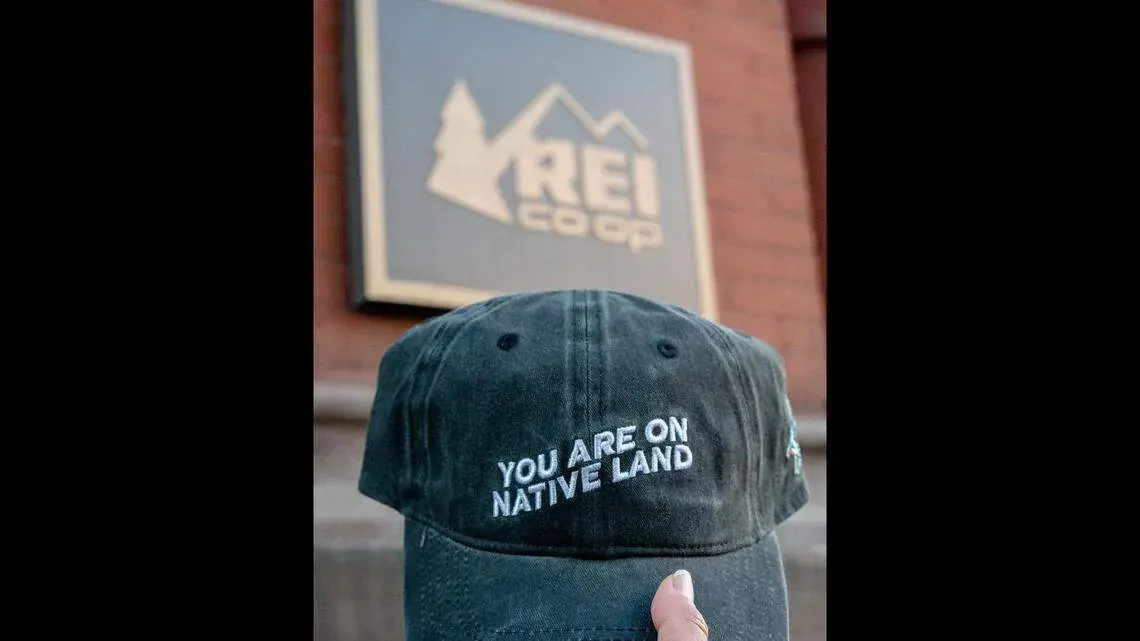
 Land acknowledgments have become increasingly common in progressive spaces and institutions. The purpose, as I understand it, is to acknowledge the past cruel and violent treatment of Native Americans as well as to show respect and support for Indigenous people. Proponents likely feel this is a way of standing up for this marginalized group of people. They are also seen by advocates as a concrete step to fostering reconciliation and support for Indigenous communities. While land acknowledgments aim to show respect for Indigenous people and past injustices, I believe they are ultimately incompatible with the liberal international order and ineffective as activism. Symbolic gestures, particularly when ritualized, risk obscuring the need for concrete, systemic change. If our goal is to support Native communities, we should prioritize policy over performance.
The Idea of “Indigenous Land”
It’s a common belief that the United States of America is “occupying” or “colonized” the land it currently claims as its own. In some sense, this is true. Americans forcibly displaced and violently mistreated the previous occupants of the land. However, the people on these lands weren’t always here. They undoubtedly experienced their own histories of conquest and violence between different nations and tribes. Even simple migration must have occurred since the dawn of time. This has been the reality across the world for most of human existence.
Take Europe as an example. Why shouldn’t northern Italy be returned to the descendants of the Etruscans? Why doesn’t London belong to the Romans who founded the city? As claimed by Russia’s dictator Vladimir Putin, why shouldn’t Ukraine be returned to the Russians who were historical shepherds of that land? These examples highlight the complexity of ancestral land claims. If we find them absurd in one context, we should question why we treat similar claims differently elsewhere. This FX TV show clip parodies this line of thinking. If we take the idea of “native land” to its logical conclusion it becomes untenable and in this exaggerated case, even ridiculous.
Let’s consider this from a geopolitical perspective, the idea of declaring native land is in the same vein as the concept of an ethnostate. It refers to a sovereign nation dominated and populated by a single racial or ethnic group. Humans have had a long history of violent conquest justified by the idea of ethnostates. Examples include Germany’s invasion of Czechoslovakia and Poland in the 1930s, Russia’s annexation of Crimea in 2014, China’s occupation and annexation of Tibet, and Somalia’s invasion of Ethiopia in the 1970s. The list could go on. It’s continuing to happen even now. Arguing that the United States, Canada, Australia, or any other western country where the practice of land acknowledgments is popular should be rightfully owned by the previous native occupants is unrealistic. It is also harmful to the cause of fostering better relationships with the sovereign native nations. While land acknowledgments are not calls for ethnic nationalism, framing land ownership around ethnicity carries echoes of ideologies that have historically justified territorial aggression. Of course, modern Indigenous movements are not equivalent to expansionist regimes. Still, it’s important to be cautious about legitimizing ethnic land claims without clear boundaries.
Telling people their land should belong to someone else is unlikely to persuade them. That’s why transfers of land ownership have historically required violence or vast transfers of other forms of wealth (e.g. The Louisiana Purchase). While some activists push for full land repatriation1, most land acknowledgments do not go this far. However, even their symbolic forms may still be problematic for the reasons I outline below.
We should be focusing on the international order brought about with great effort after WWII that justifies sovereign nations by their belonging to institutions. Territorial expansion and wars used to be commonplace but we’ve since developed frameworks and institutions to limit this kind of aggression.
United Nations Charter
All Members shall refrain in their international relations from the threat or use of force against the territorial integrity or political independence of any state, or in any other manner inconsistent with the Purposes of the United Nations.
The United States of America has formal agreements with sovereign Native nations. We should be celebrating this kind of relationship and work towards improving it for the future. It’s significant that the United States did not unilaterally take all land and instead set up sovereign reservations for different tribes. It doesn’t excuse the brutal and devastating violence inflicted upon the Native Americans but it’s the system we currently have. Support and reparations if sought after should be facilitated through this system. These moral claims of land ownership challenge the idea of institution-based, fixed borders that are foundational to international cooperation and ultimately hinder progress.
Land Acknowledgments Are Performative Activism
While these acknowledgments are symbolic, their practical effects remain questionable. Land acknowledgments often become performative acts of virtue signaling. Jeremiah Johnson has a great article titled Activism is not a Social Club on this kind of “activism”. I believe land acknowledgments fall somewhere between level 2 and level 4 of simulacra levels. There are a lot of examples of mixed feelings from indigenous organizations about the effectiveness and desirability of land acknowledgments 23. These well intentioned acts of acknowledging previous occupants of the land become a way for people to feel good about themselves by virtue signaling and absolve them of actually doing anything about the injustices they claim to care about.
Most people aren’t activists, nor do they claim to be. Mandating land acknowledgments often reduces advocacy to a performative checkbox, meant more to appease progressive norms than to foster real change. Doing the acknowledgments doesn’t do much to help the current relationship with native nations and institutions other than to say “sorry, but the land is ours now”. However, it does allow people to identify as progressive and gain the social benefits associated with that label.
During a WTA volunteer event last year our coordinator started our event with a land acknowledgment. I got the sense that this was encouraged by the WTA, but also genuinely supported by our event leader. It feels good to stand up for marginalized communities and say “I see you”. I worry though that this act can become routine and lose its meaning if not backed by concrete action. I would argue that in most cases no action follows up the acknowledgment. “Spreading awareness” is often used as a justification for this kind of speech, which I don’t find compelling.
 Instagram profile description that claims the land in the Seattle WA area as the land of the Duwamish People.
This practice can also be counterproductive because people outside progressive politics sometimes interpret it as “political correctness” or “policing speech”. I couldn’t find many public opinion polls on this subject but enough anecdotal evidence45 from opinion pieces and articles online seems to support this idea at least to some extent. Some groups and institutions encourage or mandate land acknowledgements as a part of routine meetings and events. What seems like a harmless blurb at the start of a meeting can become an annoyance to some. Alienating people because they don’t say the right things like acknowledge Native Americans before a public hearing on a city bus stop is unhelpful. I’m not saying people are getting called out for this regularly. But, if people are being told to participate in these acts of speech regularly it can lead to backlash, especially when the meeting topic has no relation to Native Americans6. I think it’s not worth spending political capital on land acknowledgments compared to other forms of activism. This can be tied into a broader critique of political speech policing and everything bagel liberalism but I’ll save that for another post.
How to Move Forward
Rather than just critique the practice of land acknowledgments, I’d like to at least offer my preferred alternative. My two big points are that land acknowledgments are incompatible with the liberal international order and that they don’t do much to support Native nations or rectify the injustices of the past. To that end, advocacy for Native nations and people should result in tangible benefits and change. I don’t claim to have a comprehensive plan but I did read several articles7 about federal and state collaboration with tribal nations and here are some ideas I liked in particular.
- Fully fund the Indian Health Service. Peg funding to inflation and population needs. This addresses healthcare, clean water, and sanitation systems. Medicare and Medicaid parity for tribal health services would also be a strong goal.
- Ensure tribal decision-making power. Tribes should have full legal authority over projects on their lands. The Squamish Nation’s development in Vancouver is a great example that is currently being fought by local NIMBYs to little avail.
- Eliminate double taxation. Businesses on tribal lands should not be taxed by both tribal and state governments. Removing this barrier would encourage economic growth.
- Expand the Treasury Department’s CDFI Fund. Increase support for Native community lenders through infrastructure investment, financial literacy training, and small business lending. While often well-intentioned, land acknowledgments are, at best, an ineffective form of activism and at worst, a counterproductive distraction from meaningful change.
Many of my thoughts were inspired by this article by Noah Smith, You are not on Indigenous Land.
Footnotes
-
Recent example as of this post. A protest in support for Palestine had speakers claiming Australia does not have a right to exist ↩
-
PBS: Analysis: How well-meaning land acknowledgments can erase Indigenous people and sanitize history ↩
-
NPR: So you began your event with an Indigenous land acknowledgment. Now what? ↩
-
LA County: County Wide Land acknowledgment Implementation Guide ↩
-
This NYT opinion piece I found concise and compelling in terms of the alternatives suggested. Enough With the Land Acknowledgments ↩